
If you have been watching Chinese dramas (C-dramas) and wondering whether all those hours are actually doing anything to help you learn Mandarin—they are. Just not the same things that structured study or HSK does. And that distinction, I have come to realise, is worth talking about properly.
I want to be upfront about something before we get into this: I am not fluent in Mandarin. I am not even close to fluent. But something has genuinely shifted in the way I hear and process the language over the past few years, and I am fairly certain C-dramas are responsible for a good chunk of that shift.
This post is part personal update, part practical breakdown. Whether you are a fellow drama addict who has started picking up phrases without meaning to, or someone ready to formalise it through the HSK exams, including the new HSK 3.0—I hope there is something useful here for you.
What C-Dramas Actually Did for My Mandarin
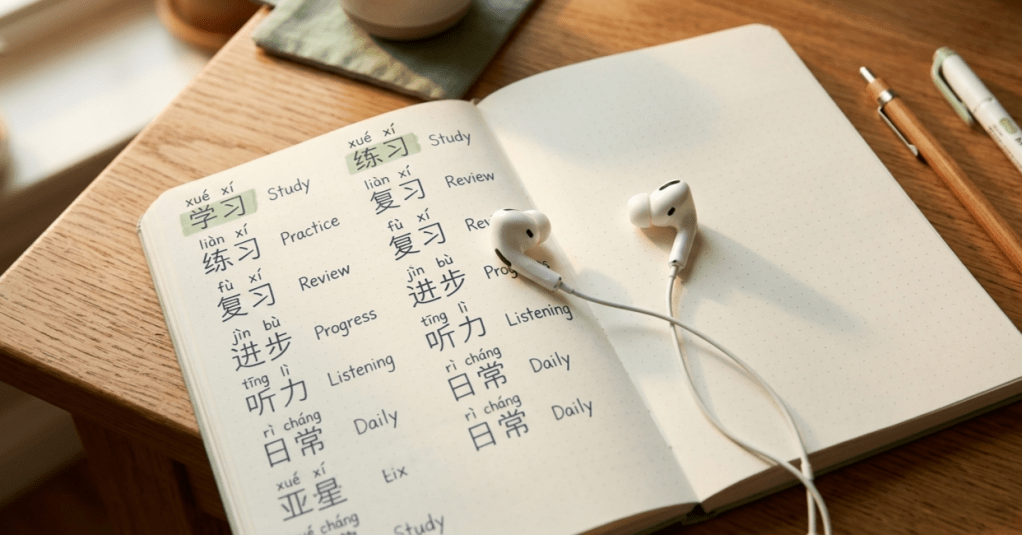
I think it is easy to either overclaim or undersell what drama-watching, listening to music and consuming media in the language your are learning does for language acquisition, so let me share my personal experience.
The most concrete change I have noticed is in my listening comprehension and vocabulary. I can now follow conversations in C-dramas at a level that genuinely surprises me when I stop and think about it—not perfectly, but the gap between what I hear and what I actually understand has narrowed in a way that feels real. Words I once drilled in isolation now arrive in dialogue with a click that is entirely different from recognising them on a flashcard. When a character says 当然 (dāngrán — of course) or 马上 (mǎshàng — right away, immediately) with the exact emotional weight of the scene behind it, it embeds differently. It sticks in a way that pure memorisation never quite managed.
My tonal ear has also improved in ways I did not entirely expect. Mandarin is a tonal language, which means the pitch contour of a syllable changes its meaning entirely, and no amount of reading about this in a textbook replicates what hours of genuine listening actually does for your brain. I have started to notice when I am pronouncing something wrong not because I have checked a chart but because it simply does not sound right anymore. That instinct came from listening, and listening came from dramas.
One drama that genuinely surprised me was Unknown (2024) — not just as a story, but because it threw Taiwanese Mandarin at me, and the differences were striking enough that I had to write about them. The tonal softness, the vocabulary shifts. Read about it in detail here: From Drama to Dialects: Lessons in Taiwanese Mandarin from Unknown (2024)
There is also something particular about contemporary, modern C-dramas that is worth flagging here if you are in the early stages of learning. Historical dramas are beautiful and I love them desperately, but they are not very reflective of how people actually speak today. Modern dramas, set in contemporary urban life, give you the rhythms and cadences of current spoken Mandarin: the contractions, the colloquialisms, the way sentences actually end in natural speech. And if you want to go even further into genuine native-speaker patterns, Chinese variety shows like Love Signal, The Truth, Divas on the Road are extraordinary for this. The slang, the banter, the way people talk over each other—it is a masterclass in living language in a way that formal content simply cannot replicate.
So yes, dramas have moved the needle. The progress is real, but it has limits, and those limits matter.
Why I Still Need Structured Study — and Why That Is Not a Contradiction
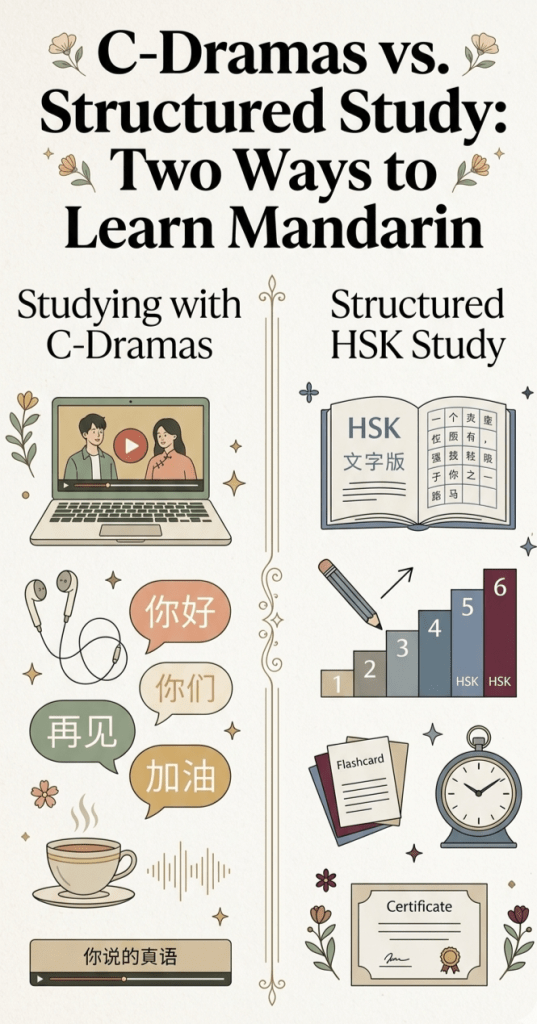
Here is the thing. Drama-based learning and structured study are not competing methods. They are not even doing the same job. Understanding what each one gives you is the key to using both well.
What dramas give you is immersion. Emotional vocabulary. Listening fluency. You absorb rhythm, tone, context, and natural phrasing in a way that is genuinely difficult to replicate through textbooks alone. This is real and it is valuable and you should absolutely keep doing it.
What structured study gives you is the scaffolding that makes all of that immersion make sense. Systematic grammar. Character recognition and writing. Vocabulary organised by level and frequency so you know what to prioritise. Exam readiness, if that is a goal for you. And, most importantly, it gives you a map. Without some structure, immersive learning can feel satisfying and vague in equal measure—you know you are improving but you cannot quite say how or where or what to work on next.
The moment I started treating my drama-watching as reinforcement of what I was formally studying, rather than an alternative to it, everything became more coherent. The two systems feed each other, and both are better for it.
If you want to take exams, get a qualification, apply for university or a job that requires Mandarin proficiency—you need the structure. Dramas will make the journey richer and more enjoyable, but they will not get you through an exam on their own.
The HSK System, Explained Simply — Including the New HSK 3.0
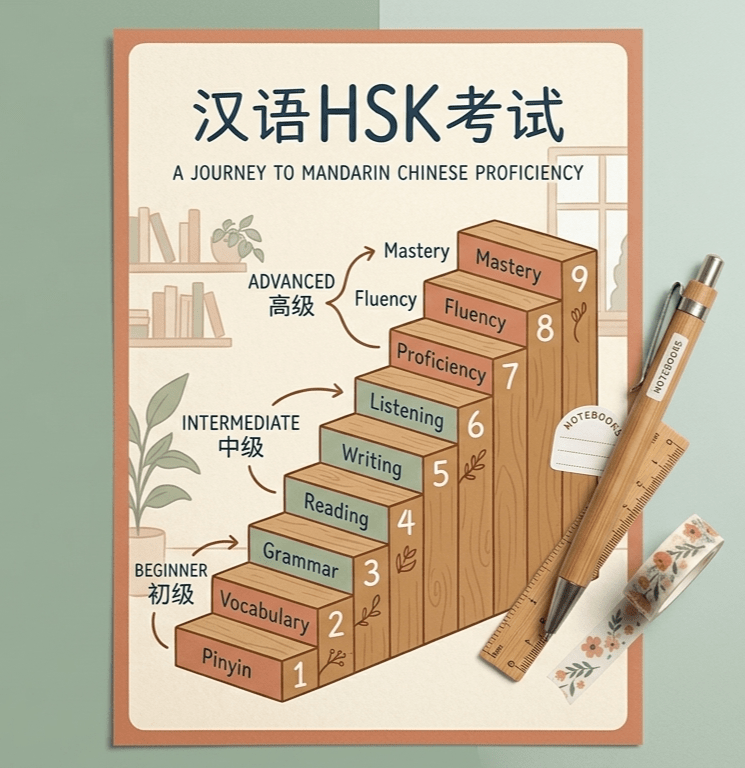
If you have been around language-learning spaces and kept seeing “HSK” mentioned without fully understanding what it is, this section is for you.
HSK (汉语水平考试, Hànyǔ Shuǐpíng Kǎoshì) is China’s official standardised Mandarin proficiency exam—the equivalent of something like IELTS or JLPT, but specifically for Mandarin Chinese. It is internationally recognised and used for university admission, visa applications, and professional contexts that require demonstrated language proficiency.
Now, here is where it gets a little confusing. The HSK has recently been restructured, and if you Google it right now you will find information about multiple different versions. Here is how they compare:
| HSK2.0 | HSK3.0 | |
| Total Levels | 6 | 9 |
| Vocab at Level 1 | 150 words | 300-500 words |
| Vocab at Level 6 | 5000 words | 5400 words |
| Speaking | Optional | Oral exam (HSKK) mandatory from Level 3 onwards |
| Skills Tested | Listening, reading, writing | Listening, reading, writing + speaking (HSK3 onwards) |
| Timeline | Active since 2010; still examined | Announced 2021; full rollout second half of 2026 |
The most significant shift is the vocabulary load. What used to be Level 3 standard is now closer to Level 2 territory under the new system — which means if you have been studying under HSK 2.0, your actual proficiency likely maps to a higher level than you think. Nothing you have learned becomes obsolete; the restructure changes the map, not the territory.
There is also an important structural change worth knowing about. The new HSK 3.0 makes a clear distinction between two separate assessments: the main exam covering listening, reading, and writing, and the HSKK (汉语水平口语考试), which is the dedicated speaking exam. The HSKK becomes a required component from HSK Level 3 onwards under the new system—a recognition that written proficiency and spoken fluency are different skills that deserve separate measurement.
One thing I want to say clearly to anyone who feels quietly panicked by all of this: the language itself does not become harder because more is required for a certain level on an exam. The restructure changes the map, not the territory. If you have been studying under the old system, every bit of it counts and carries forward.
Where I Am Right Now: HSK Level 3, Part 1
I am currently working through HSK Level 3 under the new 3.0 structure. Because the vocabulary load at each level has expanded considerably compared to the old system, I have broken Level 3 into two halves for my own sanity: Part 1 and Part 2. Right now, I am at Part 1.
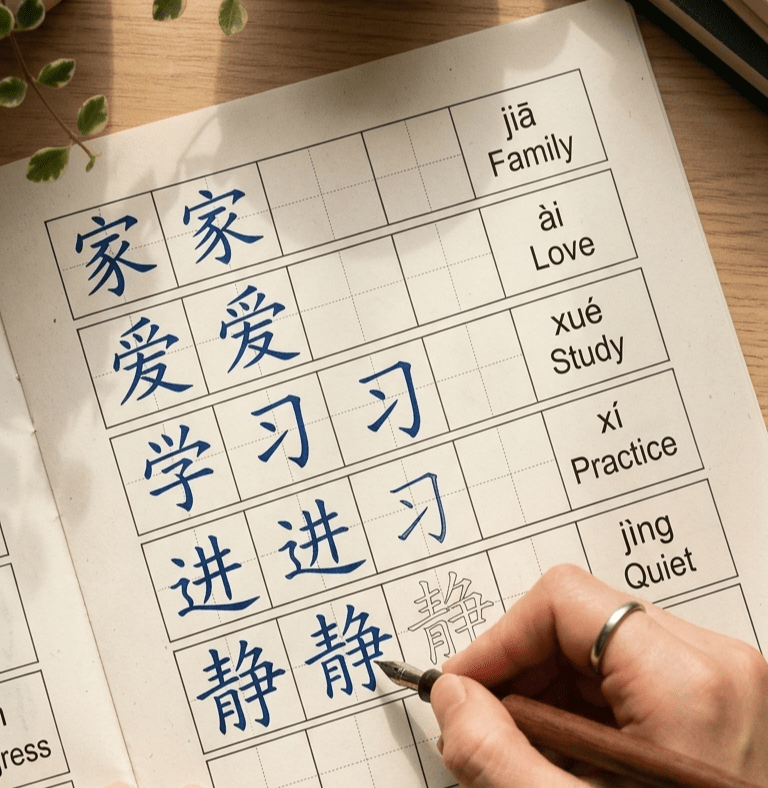
What is still challenging is character writing & memorizing. My recognition is ahead of my writing by a fair margin, which is common at this stage but still occasionally frustrating. The expanded vocabulary load of the new structure also means there is simply more to hold at once than in the old system. Which brings me to the worksheets.
The Worksheets — What They Are, How to Use Them, and Where to Find Them
I made these for myself, honestly. Writing characters repeatedly is one of the most consistently effective methods for memorising them. So I put together HSK character and vocabulary writing practice worksheets: structured around the HSK 3.0 vocabulary lists, each entry includes the character, its pinyin, and the English translation. The writing grids give you enough practice space to repeat each character properly.
The way I use them: I write each character multiple times. While I am writing, I say the word aloud, trying to connect it to a moment from a drama where I have heard it and imitating the sound—that emotional context anchor, however small, is what makes the difference between a word that stays and a word that evaporates.
The worksheets for HSK1, HSK2, and HSK3 are available as free digital downloads on my Pinterest. I made them for my own learning, they have been genuinely useful, and if they help you too that honestly makes me happy.
Learning Mandarin is a long game. Drama-watching makes it a joyful one, while structured study makes it a real one, and I need both. If you are somewhere in the middle of this same journey, I hope this has been helpful.
So—where are you in your Mandarin learning right now? Are you a drama-immersion learner who has been meaning to look into HSK? Someone already deep in the levels? Tell me in the comments! And grab the worksheets from Pinterest if they would be useful. Every stroke counts.



 The Drama Dojo
Hey everyone! I hope we can chat about dramas, share drama recommendations, language learning and more on here. So, comment away!